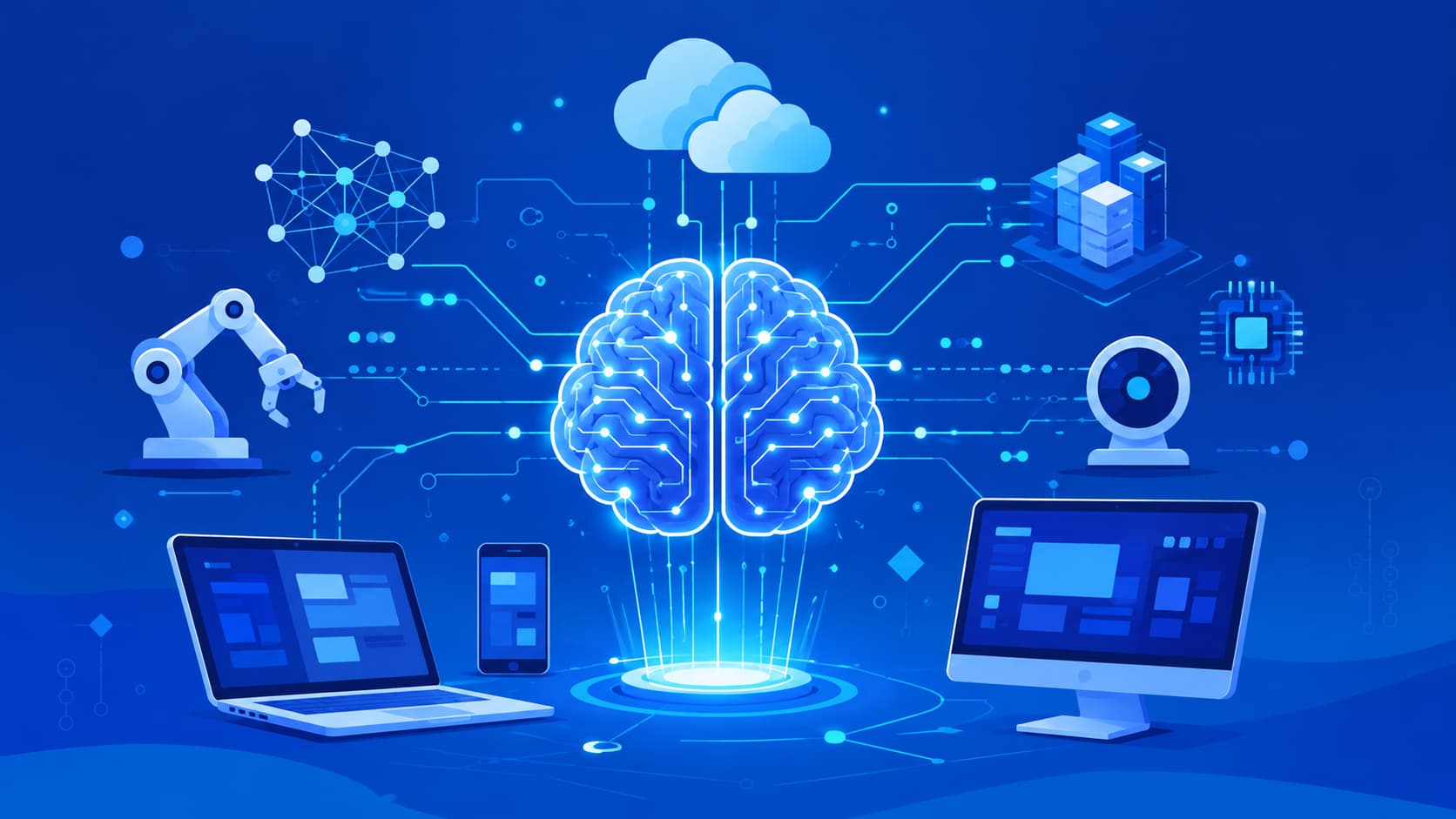
Artificial intelligence is everywhere these days, even if you don't always notice it.
You might ask an AI assistant to summarize a document, unlock your phone with facial recognition, receive movie recommendations on Netflix, or let Google Maps find the fastest route home. These everyday experiences have one thing in common: artificial intelligence is quietly working behind the scenes.
Not long ago, AI felt like something reserved for science fiction movies and futuristic robots. Today, it's become part of everyday life. Students use it to study more efficiently, professionals rely on it to boost productivity, businesses automate repetitive tasks with it, and developers use AI to write code faster.
As AI becomes more common, it's also becoming more misunderstood. Some people believe it can think exactly like a human, while others worry it will replace every job in the near future. The reality is far more interesting—and much less dramatic.
The good news is that you don't need to be a programmer or computer scientist to understand artificial intelligence. Once you understand a few core concepts, the technology starts to make a lot more sense.
In this guide, we'll explore what artificial intelligence is, how it works, where it's used, and why it's becoming one of the most important technologies of our time.
What Is Artificial Intelligence?
Artificial intelligence, often called AI, is a branch of computer science focused on creating systems that can perform tasks that typically require human intelligence.
These tasks include understanding language, recognizing images, identifying patterns, solving problems, making predictions, and generating new content.
Unlike traditional software, AI isn't limited to following a fixed set of instructions. Instead, it learns from data and improves its ability to make decisions over time.
A simple way to understand the difference is to compare a calculator with a navigation app.
A calculator follows exact mathematical rules every time you press a button. It never learns from previous calculations.
A navigation app, on the other hand, analyzes live traffic conditions, road closures, driving habits, and historical travel data before suggesting the fastest route. That's a practical example of AI making decisions based on patterns instead of rigid instructions.
Another way to think about AI is to imagine teaching someone to recognize different breeds of dogs.
Instead of describing every possible characteristic, you simply show them hundreds of photos. After seeing enough examples, they begin recognizing dogs they've never seen before.
Many AI systems learn in a similar way. They aren't memorizing every answer—they're learning patterns from enormous amounts of data.
That's what makes artificial intelligence so powerful. It allows computers to solve problems that would be nearly impossible using traditional programming alone.
Why Artificial Intelligence Matters
Artificial intelligence is no longer a technology that's only used by researchers or large technology companies. It's becoming part of the digital tools millions of people rely on every day.
Whether you're shopping online, searching the web, translating another language, or filtering spam emails, AI is likely helping behind the scenes.
Here are just a few examples of how AI has become part of everyday life:
- Unlocking your smartphone with Face ID or fingerprint recognition.
- Receiving personalized recommendations on Netflix, YouTube, or Spotify.
- Asking AI assistants to answer questions or summarize information.
- Using Google Maps to avoid traffic congestion.
- Filtering spam messages from your email inbox.
- Translating conversations into another language almost instantly.
Businesses have embraced AI just as quickly.
Customer support teams use AI-powered chatbots to answer common questions around the clock. Marketing teams analyze customer behavior to create more relevant campaigns. Doctors use AI to help detect diseases from medical scans, while software developers use coding assistants to speed up development.
In many industries, AI isn't replacing people. Instead, it's helping them work faster, reduce repetitive tasks, and make more informed decisions.
For that reason alone, understanding the basics of artificial intelligence is becoming an increasingly valuable skill—not just for technology professionals, but for anyone who uses digital tools.
A Brief History of Artificial Intelligence
Although artificial intelligence feels like a modern breakthrough, the idea has been around for much longer than most people realize.
The journey began in the 1950s when researchers started asking a simple but ambitious question: could a machine be taught to solve problems the way humans do?
The Early Days
Early AI research focused on creating programs that could solve puzzles, play games, and perform logical reasoning. Computers at the time were incredibly limited, so progress was slow, but the foundation for modern AI had already been established.
The Rise of Machine Learning
As computers became more powerful and the internet generated enormous amounts of digital information, researchers discovered a better approach.
Instead of manually programming every possible rule, they began teaching computers to learn directly from data.
This shift gave birth to machine learning, one of the technologies that powers most AI systems today.
The Modern AI Era
Recent advances in computing power and deep learning have accelerated AI development dramatically.
Today's AI models can generate realistic images, write articles, translate languages, summarize long documents, create software code, and hold surprisingly natural conversations.
What once seemed impossible has become part of everyday life in just a few years.
How Does Artificial Intelligence Work?
At first glance, AI can seem almost magical.
You ask a question, upload an image, or describe an idea, and within seconds an AI system produces a useful response.
Behind the scenes, however, the process is based on mathematics, data, and pattern recognition rather than magic.
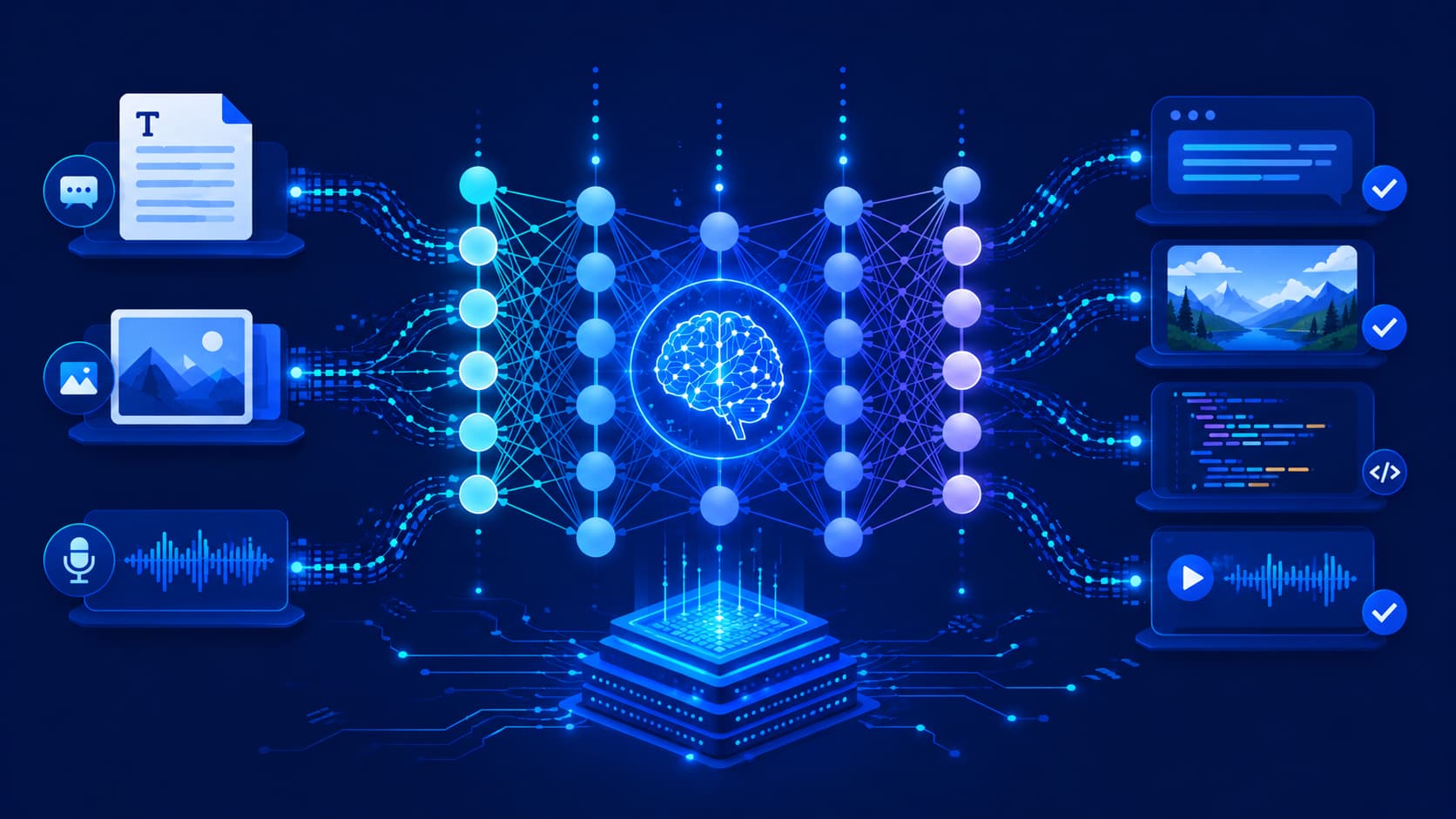
Most AI systems follow four basic steps:
- Collect large amounts of relevant data.
- Learn patterns from that data during training.
- Build a model capable of recognizing similar patterns.
- Use that model to make predictions or generate responses.
Imagine teaching a child how to recognize different kinds of fruit.
Rather than explaining every tiny detail about apples, oranges, and bananas, you simply show enough examples until they begin recognizing them on their own.
AI learns in much the same way.
Instead of looking at a few dozen examples, modern AI models may analyze millions—or even billions—of data points before they become accurate enough for real-world use.
Of course, learning from data doesn't make AI perfect.
If the training data contains errors or lacks diversity, the AI may produce inaccurate or biased results. That's why high-quality data and responsible development remain essential parts of modern artificial intelligence.
Types of Artificial Intelligence
If you've spent any time reading about AI, you've probably come across terms like machine learning, generative AI, or large language models. It's easy to assume they're all the same thing, but they're not.
Artificial intelligence can be divided into different categories based on what it's capable of doing.
Narrow AI
Narrow AI, sometimes called Weak AI, is designed to perform a specific task extremely well.
It doesn't understand the world the way humans do, and it can't suddenly learn something completely unrelated to its original purpose.
Almost every AI tool available today falls into this category.
Examples include:
- ChatGPT answering questions.
- Google Translate translating languages.
- Spotify recommending music.
- Netflix suggesting movies.
- Face ID recognizing your face.
- Gmail filtering spam emails.
Each system is trained to solve a particular problem, and that's exactly what it does.
General AI
General AI refers to a machine that could learn, reason, and adapt much like a human being.
Instead of being limited to one task, it would be able to solve unfamiliar problems, learn new skills on its own, and apply knowledge across different situations.
While General AI is discussed frequently in research and the media, it doesn't exist today.
Superintelligent AI
Superintelligent AI is a theoretical concept describing a machine that surpasses human intelligence in virtually every area.
At the moment, this remains a topic of research and debate rather than reality.
For now, the AI tools we interact with every day are all examples of Narrow AI.
Artificial Intelligence vs Machine Learning
One of the biggest misconceptions is that artificial intelligence and machine learning mean the same thing.
They don't.
Think of artificial intelligence as the bigger picture.
Machine learning is one of the methods used to make AI possible.
Imagine you're building a house.
Artificial intelligence is the entire house, while machine learning is one of the most important construction tools used to build it.
Without machine learning, many modern AI systems wouldn't exist.
Machine learning allows computers to learn from examples instead of relying entirely on manually written instructions.
For example, if you wanted a computer to recognize cats twenty years ago, developers would have needed to describe countless characteristics manually.
With machine learning, the computer simply learns from millions of cat images until it starts recognizing new ones on its own.
That's why machine learning has become the foundation of today's AI revolution.
What Is Deep Learning?
Deep learning is a more advanced form of machine learning.
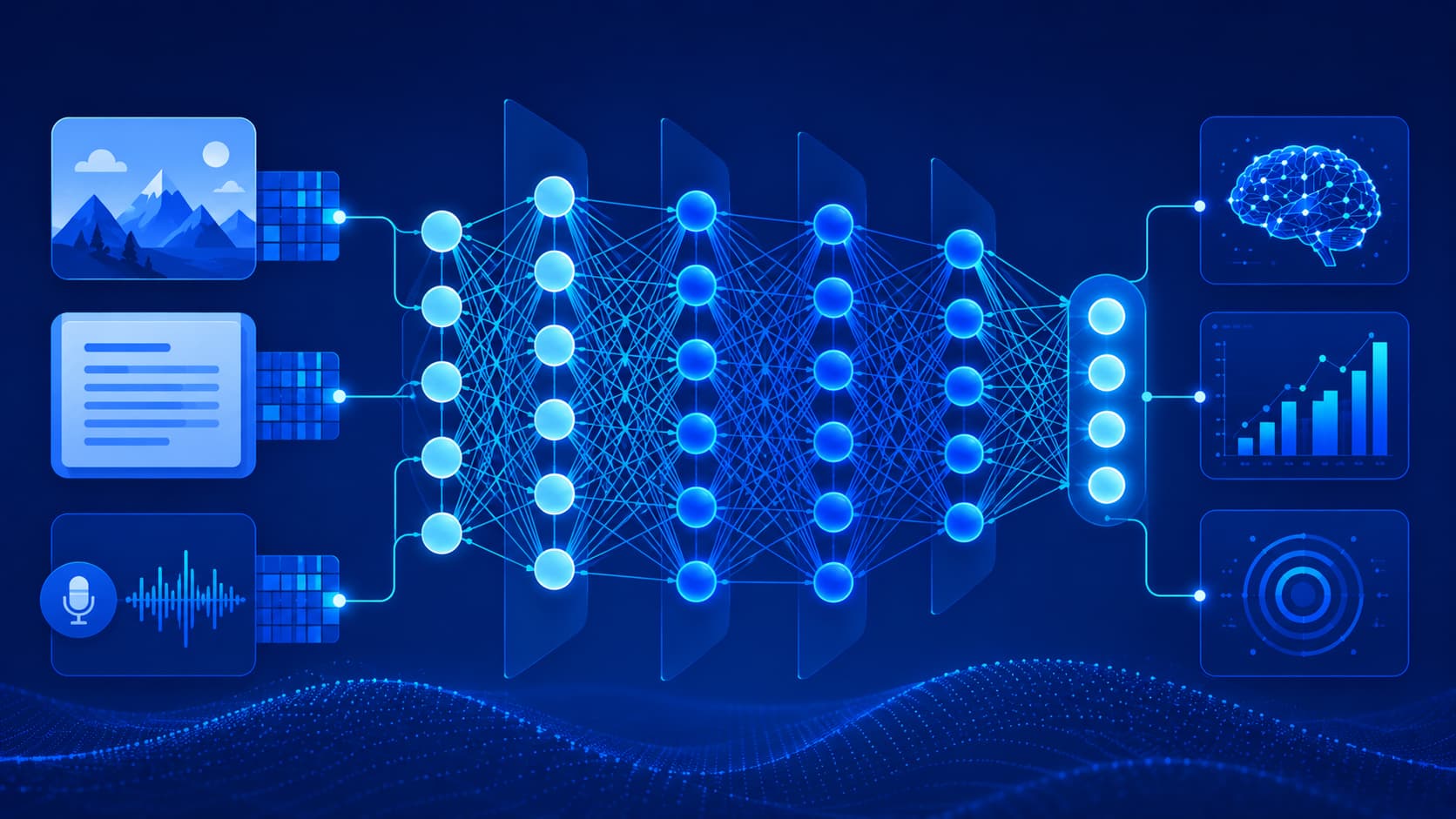
It uses artificial neural networks inspired by the way neurons communicate inside the human brain.
Don't let the name intimidate you.
You don't need to understand neuroscience to understand the basic idea.
The word deep simply refers to multiple layers of processing.
Each layer gradually recognizes more complex patterns than the previous one.
Imagine looking at a photograph.
At first, you notice simple shapes and colors.
Then you recognize eyes, noses, and mouths.
Finally, you recognize the entire person's face.
Deep learning works in a similar way.
This technology powers many AI applications we use today, including:
- Voice assistants.
- Image recognition.
- Speech-to-text software.
- Self-driving car research.
- Modern AI chatbots.
- AI image generators.
Without deep learning, today's AI would be far less capable.
What Is Generative AI?
Generative AI is one of the fastest-growing areas of artificial intelligence.
Unlike traditional AI systems that classify or analyze information, generative AI creates something entirely new.
Depending on the model, it can generate:
- Articles
- Images
- Videos
- Music
- Computer code
- Presentations
- Audio
- Marketing content
Popular examples include ChatGPT, Claude, Google Gemini, Microsoft Copilot, Midjourney, and DALL·E.
What makes generative AI exciting isn't that it replaces creativity.
It's that it helps people turn ideas into drafts much faster than before.
A designer can generate concepts.
A programmer can write boilerplate code.
A marketer can brainstorm campaign ideas.
A student can simplify difficult topics.
The final result still benefits from human judgment, but AI significantly reduces the time needed to get started.
Where Is Artificial Intelligence Used?
One reason AI has grown so quickly is that it's useful in almost every industry.
You don't have to work in technology to benefit from it.
Healthcare
Doctors use AI to help analyze medical scans, identify diseases earlier, and support research into new treatments.
AI doesn't replace medical professionals, but it can help them make faster and more informed decisions.
Education
Students use AI to explain complex topics, summarize lessons, practice foreign languages, and organize study materials.
Teachers also use AI to prepare lesson plans and reduce repetitive administrative work.
Business
Companies rely on AI for customer support, document processing, forecasting, marketing analysis, and workflow automation.
Many repetitive tasks that once took hours can now be completed in minutes.
Software Development
Developers use AI coding assistants to explain unfamiliar code, suggest improvements, identify bugs, and automate repetitive programming tasks.
Rather than replacing developers, AI often acts like a collaborative assistant.
Entertainment
Streaming platforms use AI to recommend movies, TV shows, podcasts, and music based on your viewing or listening habits.
The recommendations become more accurate as the system learns your preferences over time.
Finance
Banks and financial institutions use AI to detect fraud, evaluate financial risks, and improve customer service.
Every time your bank notices suspicious activity on your account, there's a good chance AI helped identify it.
Benefits of Artificial Intelligence
It's easy to focus on the headlines about AI, but its biggest impact often comes from helping people save time and work more efficiently.
When used responsibly, artificial intelligence offers several practical benefits.
It saves time
Many repetitive tasks that once took hours can now be completed in minutes.
Whether it's organizing documents, summarizing long reports, or sorting thousands of emails, AI can handle routine work much faster than a person.
That gives people more time to focus on creative thinking and decision-making.
It improves productivity
AI doesn't get tired, distracted, or bored.
Businesses use AI to automate repetitive workflows, while individuals use it to brainstorm ideas, write first drafts, organize schedules, or analyze information more efficiently.
Rather than replacing human effort, AI often helps people accomplish more in less time.
It can reduce human error
Mistakes are part of being human.
AI can help reduce those mistakes, especially in tasks that require analyzing large amounts of information.
For example, AI can assist doctors in reviewing medical images or help financial institutions identify suspicious transactions that might otherwise go unnoticed.
Of course, AI isn't perfect, but it can serve as an additional layer of support.
It makes technology more accessible
Features like live captions, language translation, voice recognition, and text-to-speech have made digital products easier to use for millions of people.
Many accessibility tools available today are powered by artificial intelligence.
The Limitations of Artificial Intelligence
As impressive as AI can be, it's important to understand what it can't do.
Knowing its limitations helps you use AI more effectively and avoid unrealistic expectations.
AI doesn't truly understand information
One of the biggest misconceptions is that AI "thinks" like a human.
It doesn't.
Most AI systems predict the most likely response based on patterns they learned during training.
That means AI can produce convincing answers without actually understanding the topic in the way people do.
AI can be wrong
If you've ever used an AI chatbot, you've probably seen it confidently provide an incorrect answer.
This happens because AI generates responses based on probability, not certainty.
That's why important information—especially medical, financial, or legal advice—should always be verified using reliable sources.
AI depends on data
An AI system is only as good as the data it learns from.
If the training data contains errors, outdated information, or bias, those issues can appear in the AI's responses as well.
Improving data quality remains one of the biggest challenges in AI development.
Human judgment is still essential
AI is an excellent assistant, but it's rarely the final decision-maker.
Whether you're writing an article, reviewing software code, or analyzing business data, human experience and critical thinking remain essential.
The best results usually come from people and AI working together.
Common Myths About Artificial Intelligence
Because AI evolves so quickly, misconceptions spread just as fast.
Let's clear up a few of the most common ones.
"AI is going to replace every job."
Some jobs will certainly change, and certain repetitive tasks will become automated.
However, history shows that new technologies often create new opportunities while changing the nature of existing work.
People who learn how to use AI effectively are likely to have an advantage over those who ignore it completely.
"AI is always accurate."
AI can sound incredibly confident, even when it's wrong.
That's why it's important to fact-check important information instead of accepting every answer at face value.
"Only programmers need to learn AI."
Not anymore.
Today, writers, designers, marketers, teachers, students, entrepreneurs, and healthcare professionals are all finding practical ways to use AI in their daily work.
Understanding the basics has become a valuable digital skill regardless of your profession.
The Future of Artificial Intelligence
Artificial intelligence is still evolving, and we're only beginning to see what's possible.
In the coming years, AI is expected to become even more integrated into the products and services we use every day.
Instead of opening a separate AI application, many people will simply interact with AI built directly into their favorite software.
We'll likely see smarter search engines, more capable virtual assistants, better healthcare tools, personalized learning experiences, and more efficient workplace automation.
At the same time, discussions about privacy, transparency, copyright, and responsible AI development will become increasingly important.
The future of AI isn't just about building smarter technology.
It's also about making sure that technology benefits people in meaningful and responsible ways.
Key Takeaways
If you only remember a few things from this guide, let them be these:
- Artificial intelligence enables computers to perform tasks that normally require human intelligence.
- Most AI systems available today are examples of Narrow AI.
- Machine learning is one of the technologies that makes modern AI possible.
- Generative AI creates original content such as text, images, code, and videos.
- AI is already improving healthcare, education, business, software development, and many other industries.
- While AI is powerful, it still requires human judgment and responsible use.
Frequently Asked Questions
What is artificial intelligence in simple terms?
Artificial intelligence is technology that allows computers to perform tasks such as learning, recognizing patterns, solving problems, and generating content that would normally require human intelligence.
Is ChatGPT considered artificial intelligence?
Yes. ChatGPT is an AI application built on a large language model (LLM) that can understand and generate human-like text.
What's the difference between AI and machine learning?
Artificial intelligence is the broader field, while machine learning is one of the techniques used to build AI systems that learn from data.
Can artificial intelligence think like humans?
No. Current AI systems recognize patterns and generate responses based on data, but they don't possess human consciousness, emotions, or self-awareness.
Is AI safe to use?
AI can be very useful when used responsibly. However, it's always important to verify important information and be mindful of privacy and data security.
Conclusion
Artificial intelligence is no longer a glimpse into the future—it's already part of everyday life.
Whether you're using an AI assistant to answer questions, relying on navigation apps to avoid traffic, or receiving personalized recommendations while shopping online, AI is quietly helping millions of people every day.
The technology will continue to evolve, but one thing is already clear: understanding the basics of artificial intelligence is becoming just as valuable as understanding how the internet or smartphones changed the world years ago.
You don't need to become an AI expert overnight.
Simply learning how AI works, what it can do, and where its limitations lie will help you make better decisions as new tools continue to emerge.
As you become more familiar with the technology, you'll be in a much better position to use AI as a tool—not as something mysterious, but as something practical that can help you learn, create, and solve problems more effectively.