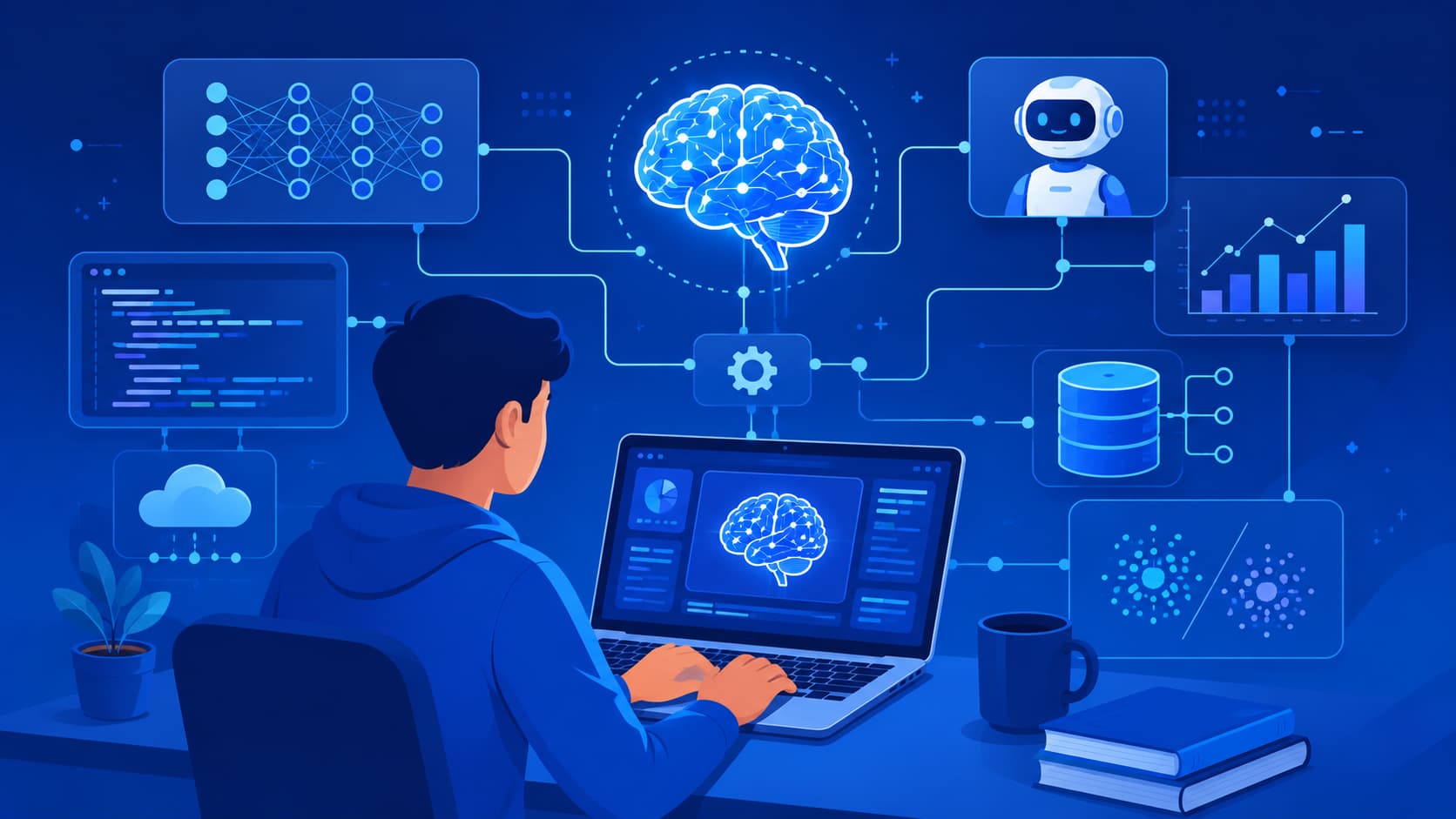
A lot of people want to learn artificial intelligence.
The problem isn't a lack of interest—it's knowing where to begin.
Search for "learn AI" online and you'll quickly find thousands of tutorials, online courses, YouTube videos, and books. Some tell you to learn Python first. Others say you should start with mathematics. A few even suggest building your own AI model on day one.
It's no surprise that many beginners end up feeling overwhelmed before they even write a single line of code.
Here's the good news.
You don't have to understand everything at once.
Artificial intelligence is a broad field, and like any new skill, it's much easier to learn when you break it into smaller steps.
Whether you're a student, a professional looking to expand your skills, or simply curious about how AI works, having a clear roadmap makes the journey much more enjoyable.
This guide isn't about becoming an AI researcher overnight.
It's about building a strong foundation so every new concept becomes easier to understand.
Do You Need a Technical Background?
One of the biggest myths surrounding AI is that only programmers can learn it.
That's simply not true.
If your goal is to understand how AI works and use modern AI tools effectively, you don't need a computer science degree.
In fact, many people begin learning AI from completely different backgrounds.
Teachers use AI to prepare lesson plans.
Designers use AI to generate creative ideas.
Marketers use AI to improve campaigns.
Business owners automate repetitive tasks.
Writers brainstorm content more efficiently.
The skills you need depend on what you want to achieve.
Someone who wants to build AI applications will follow a different path than someone who simply wants to use AI as part of their daily work.
The important thing is to start with the fundamentals rather than jumping straight into advanced topics.
Step 1: Understand the Basics of Artificial Intelligence
Before thinking about algorithms or programming languages, take time to understand the core ideas behind AI.
You should be comfortable answering questions like:
- What is artificial intelligence?
- How does AI learn from data?
- What's the difference between AI and machine learning?
- What are the different types of AI?
- What is generative AI?
Understanding these concepts gives you context for everything else you'll learn later.
Without that foundation, it's easy to memorize terms without truly understanding how they connect.
Step 2: Learn How Machine Learning Fits Into AI
Once you understand the big picture, the next step is learning about machine learning.
Many beginners mistakenly think machine learning and artificial intelligence are the same thing.
They're closely related, but they're not interchangeable.
Machine learning is one of the technologies that allows AI systems to improve by learning from data.
Understanding this relationship helps explain why AI has advanced so rapidly over the last decade.
Don't worry about building your own models yet.
Focus on understanding the concepts first.
Step 3: Decide Whether You Want to Build AI or Use AI
At this point, your learning path begins to split into two different directions.
If you're interested in creating AI applications, you'll eventually need programming skills, mathematics, and experience working with data.
If your goal is to use AI to improve your productivity, you can focus on learning how to communicate effectively with AI tools, evaluate their responses, and integrate them into your daily workflow.
Neither path is better than the other.
They simply lead to different outcomes.
Choosing your direction early helps you avoid spending time on topics that aren't relevant to your goals.
Step 4: Learn Programming Only If You Need It
One question comes up almost every time someone starts learning AI:
"Do I need to learn programming?"
The answer depends on your goal.
If you simply want to use AI tools to become more productive, the answer is no.
Many professionals use AI every day without writing a single line of code. Writers brainstorm ideas, marketers generate campaign drafts, designers explore creative concepts, and entrepreneurs automate repetitive tasks—all by learning how to use AI effectively.
However, if your goal is to build AI applications, train machine learning models, or develop intelligent software, programming eventually becomes an essential skill.
The good news is that you don't need to learn everything at once.
Start with one language, understand the basics, and build from there.
For most beginners, Python is the best place to start because it's widely used in artificial intelligence, has a simple syntax, and offers an enormous collection of AI libraries and learning resources.
Step 5: Don't Worry Too Much About Mathematics
Another reason many people delay learning AI is because they believe they need advanced mathematics before they can even begin.
While mathematics is certainly important for building AI systems, it's not the first thing most beginners should focus on.
Think of it like learning to drive.
You don't need to understand how an engine works before you can safely drive a car.
In the same way, you can understand the concepts behind AI long before you dive into topics like linear algebra, probability, or calculus.
As your knowledge grows, you'll naturally discover which mathematical concepts are worth learning.
Trying to learn everything from the beginning often creates unnecessary frustration.
Step 6: Practice With Real AI Tools
Reading articles and watching tutorials can teach you the theory, but nothing replaces hands-on experience.
The best way to become comfortable with AI is to start using it.
Ask questions.
Summarize long documents.
Generate ideas.
Rewrite emails.
Translate text.
Organize notes.
Experiment with different prompts and compare the results.
The more you interact with AI tools, the better you'll understand both their strengths and their limitations.
You'll also begin developing an important skill that many beginners overlook: knowing when AI can help—and when it can't.
Step 7: Build Small Projects
If you're interested in creating AI applications, don't wait until you feel like an expert.
Start small.
A simple chatbot.
A text summarizer.
An image classifier.
A recommendation system.
None of these projects need to be perfect.
Their purpose is to help you apply what you've learned.
Every small project teaches lessons that no tutorial can fully explain.
Progress comes from building, testing, making mistakes, and improving over time.
Common Mistakes Beginners Make
Learning AI is exciting, but it's easy to fall into a few common traps.
Trying to Learn Everything at Once
Artificial intelligence is an enormous field.
Attempting to master every topic simultaneously usually leads to confusion instead of progress.
Focus on one concept at a time.
Skipping the Fundamentals
Many beginners jump directly into advanced tutorials because they want quick results.
Without understanding the basics, however, those tutorials often become difficult to follow.
A strong foundation will save you time in the long run.
Collecting Courses Without Practicing
Buying online courses feels productive, but real learning happens when you apply what you've studied.
Even small experiments can teach you more than hours of passive watching.
Comparing Yourself to Experts
It's easy to look at experienced AI engineers and feel like you're falling behind.
Remember that everyone starts somewhere.
The goal isn't to know everything today.
The goal is to understand a little more than you did yesterday.
A Simple Learning Roadmap
If you're unsure where to begin, this roadmap provides a practical starting point.
- Understand what artificial intelligence is.
- Learn how machine learning fits into AI.
- Explore generative AI and popular AI tools.
- Decide whether you want to build AI or simply use it effectively.
- Learn Python if software development is your goal.
- Practice using AI in real-world situations.
- Build small projects to reinforce your knowledge.
- Continue learning as new technologies emerge.
You don't need to rush through these steps.
Everyone learns at a different pace, and consistency is far more valuable than speed.
Frequently Asked Questions
How long does it take to learn artificial intelligence?
It depends on your goals.
If you only want to understand the fundamentals and use AI tools effectively, you can build a solid foundation within a few weeks of consistent learning.
Becoming an AI engineer or machine learning specialist, however, usually requires months or even years of study and practical experience.
Is Python required for AI?
Not if your goal is simply to use AI tools.
However, Python is the most popular programming language for building AI and machine learning applications.
Can I learn AI without a computer science degree?
Absolutely.
Many people working with AI today come from backgrounds such as business, marketing, education, design, and healthcare.
A degree can be helpful, but curiosity and consistent practice matter just as much.
What's the best way to learn AI?
The most effective approach combines theory with practice.
Learn the concepts, experiment with real AI tools, build small projects, and continue improving through regular hands-on experience.
Is AI difficult to learn?
It can seem intimidating at first because of the unfamiliar terminology.
Once you understand the core concepts, however, learning becomes much more manageable.
The key is to take one step at a time instead of trying to learn everything at once.
Conclusion
Learning artificial intelligence doesn't have to be overwhelming.
The biggest challenge for most beginners isn't intelligence—it's knowing where to start.
Once you understand the fundamentals and follow a clear roadmap, every new topic becomes easier to connect.
Whether your goal is to build AI applications, improve your career, or simply understand the technology shaping today's world, the most important step is the first one.
Don't wait until you feel completely ready.
Start learning, stay curious, and keep practicing.
Artificial intelligence is evolving quickly, but there's never been a better time to begin your journey.