
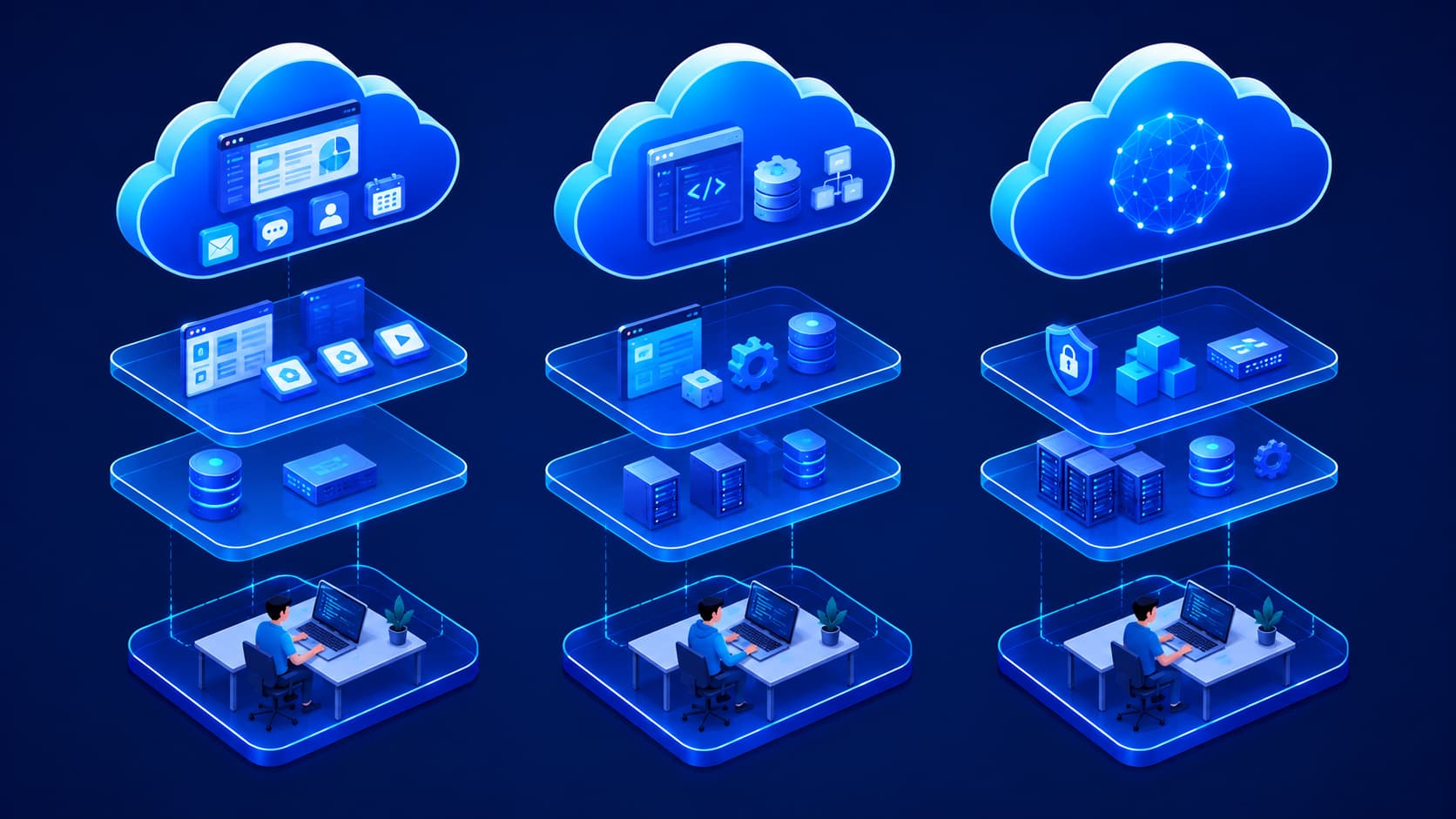
If you've been learning about cloud computing, you've probably come across three acronyms that appear almost everywhere: SaaS, PaaS, and IaaS.
At first glance, they can feel like confusing technical jargon.
Many beginners assume they're different cloud providers or separate technologies.
In reality, they're simply different ways of delivering cloud services.
The easiest way to think about them is as different levels of responsibility.
Sometimes you want a service that's completely ready to use.
Other times, you want more control so you can build, customize, or manage your own applications.
That's exactly why these three service models exist.
Each one offers a different balance between convenience, flexibility, and control.
Understanding the differences will make it much easier to choose the right cloud solution, whether you're an everyday user, a business owner, or someone starting a career in cloud and DevOps.
Why Are There Different Cloud Service Models?
Not everyone uses cloud computing in the same way.
A student who needs online document editing has very different requirements from a software developer building a web application.
Likewise, a startup launching a new product has different infrastructure needs than a global enterprise managing thousands of servers.
Instead of offering a single type of service, cloud providers created multiple service models to meet these different needs.
Some services focus on simplicity.
Others provide greater flexibility and control.
Choosing the right model depends on what you want to accomplish rather than which option is considered "better."
Software as a Service (SaaS)
Software as a Service, commonly known as SaaS, is the simplest cloud service model.
With SaaS, the software is fully developed, hosted, and maintained by the provider.
Users simply open the application through a web browser or install a lightweight client and begin using it.
There's no need to purchase servers, install complex software, or manage updates.
Everything happens behind the scenes.
For most people, SaaS is the type of cloud computing they use every day without realizing it.
Email platforms, online office suites, video conferencing tools, project management software, and music streaming services are all examples of SaaS.
Why Is SaaS So Popular?
SaaS removes many of the technical responsibilities that traditionally came with software.
Users don't need to worry about installing updates, replacing servers, or maintaining infrastructure.
They simply access the application whenever they need it.
This convenience makes SaaS an excellent choice for individuals, small businesses, and organizations that want to start using software quickly without managing the underlying technology.
Platform as a Service (PaaS)
While SaaS provides finished software, Platform as a Service (PaaS) is designed for developers.
Instead of delivering a complete application, PaaS provides a ready-to-use environment where developers can build, test, deploy, and manage their own applications.
The cloud provider handles the underlying infrastructure, operating systems, and much of the platform maintenance.
Developers can focus on writing code instead of configuring servers.
This significantly reduces the time required to launch new applications.
PaaS has become especially popular among software development teams because it simplifies many of the repetitive tasks involved in application deployment.
Infrastructure as a Service (IaaS)
Infrastructure as a Service, or IaaS, offers the highest level of flexibility among the three cloud service models.
Instead of providing ready-to-use software or a development platform, IaaS gives customers access to the fundamental building blocks of IT infrastructure.
These resources typically include virtual servers, storage, networking, and other computing services.
Rather than purchasing physical hardware, organizations rent these resources from a cloud provider and configure them according to their own requirements.
This approach gives businesses complete control over their operating systems, applications, security settings, and network configurations.
It's a popular choice for companies that need maximum flexibility without the expense of building and maintaining their own data centers.
Comparing SaaS, PaaS, and IaaS
The easiest way to understand these service models is to look at how much responsibility belongs to the customer.
With SaaS, almost everything is managed by the provider.
Users simply sign in and start using the software.
With PaaS, the provider manages the infrastructure and development platform, while developers focus on building and deploying applications.
With IaaS, customers have much greater control, but they also take on more responsibility for configuring and managing their own environments.
A simple way to think about it is this:
- SaaS lets you use software.
- PaaS lets you build software.
- IaaS lets you build the infrastructure where software runs.
Each model serves a different purpose, and many organizations use more than one at the same time.
Real-World Examples
Understanding the concepts becomes much easier when you see how they're used in practice.
A company using Google Workspace or Microsoft 365 is using SaaS because the applications are fully managed by the provider.
A software development team deploying an application with Google App Engine or Azure App Service is using PaaS because the platform handles much of the underlying infrastructure.
An organization launching virtual machines on Amazon EC2 or Google Compute Engine is using IaaS because it manages the operating system, applications, and server configuration itself.
Although these examples belong to different service models, they often work together within the same organization.
A business might use SaaS for communication, PaaS for application development, and IaaS for hosting custom workloads.
Which Service Model Should You Choose?
There's no single model that's best for everyone.
The right choice depends on what you're trying to accomplish.
If you simply need software that's ready to use, SaaS is usually the most practical option.
If you're developing applications and want to avoid managing servers, PaaS provides an efficient development environment.
If your organization requires complete control over infrastructure, networking, and operating systems, IaaS offers the greatest flexibility.
As businesses grow, it's common for them to combine all three service models to meet different operational needs.
Rather than replacing one another, SaaS, PaaS, and IaaS complement each other.
Frequently Asked Questions
What do SaaS, PaaS, and IaaS stand for?
- SaaS stands for Software as a Service.
- PaaS stands for Platform as a Service.
- IaaS stands for Infrastructure as a Service.
Each represents a different way of delivering cloud services.
Which cloud service model is the easiest to use?
SaaS is generally the easiest because the provider manages the software, infrastructure, maintenance, and updates.
Users simply access the application and begin working.
Do businesses use more than one service model?
Yes.
Many organizations use a combination of SaaS, PaaS, and IaaS depending on their needs.
For example, a company may use SaaS for email, PaaS for software development, and IaaS for hosting custom applications.
Is IaaS better than SaaS?
Not necessarily.
IaaS offers more control, while SaaS offers greater simplicity.
The better choice depends on the level of flexibility and management your organization requires.
Why are SaaS, PaaS, and IaaS important?
These service models make cloud computing more flexible by allowing users to choose how much of the underlying technology they want to manage themselves.
Conclusion
SaaS, PaaS, and IaaS represent three different ways of using cloud computing, each designed for a different level of responsibility and control.
SaaS makes software easy to access without worrying about maintenance.
PaaS provides developers with a streamlined environment for building and deploying applications.
IaaS delivers flexible infrastructure that organizations can configure to meet their own requirements.
Understanding these service models is an important step in learning cloud computing because they appear throughout modern IT environments, cloud certifications, and enterprise technology strategies.
Rather than competing with one another, they work together to support everything from personal productivity tools to large-scale business applications.